




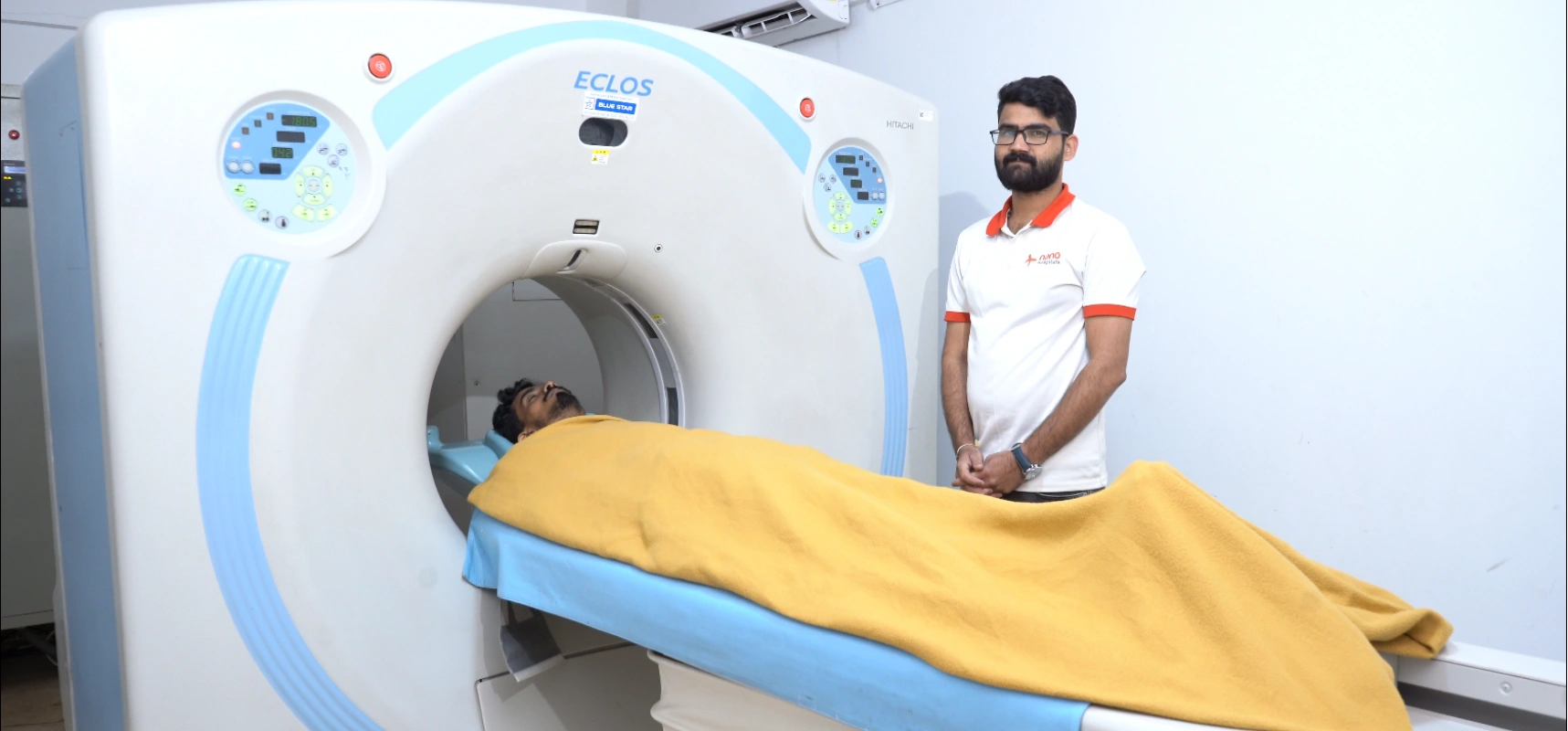
CT Scan
CT Scan at Nano Hospitals uses X-rays and computer processing to create detailed cross-sectional images of the body. It is used to evaluate conditions including injuries, bleeding, infections, tumours, fractures and organ abnormalities, with CT services available at both Bangalore branches.
About CT Scan
A CT (Computed Tomography) scan at Nano Hospitals is an advanced diagnostic imaging procedure that uses X-rays and computer technology to produce detailed cross-sectional images of the body. It provides clear views of bones, organs, blood vessels, and soft tissues, helping doctors evaluate various medical conditions with speed and precision.
CT scans are commonly used to examine the head, chest, abdomen, pelvis, and other areas of the body.
Overview
A CT (Computed Tomography) Scan is an advanced diagnostic imaging test that uses X-rays and computer processing to produce detailed cross-sectional images of the body. It plays a critical role in identifying internal injuries, bleeding, infections, tumours, fractures, and organ abnormalities—especially when rapid, accurate diagnosis is essential.
Workflow
CT scanning at Nano Hospitals follows a patient-focused, time-efficient workflow:
- Step 1: Clinical Assessment The treating doctor evaluates symptoms and determines the need for a CT scan.
- Step 2: Scan Planning The specific body area is identified, and contrast use (if required) is decided.
- Step 3: Image Acquisition The scan is performed within seconds while the patient lies comfortably on the scanning table.
- Step 4: Image Processing & Review Images are reconstructed instantly and reviewed by specialists to guide treatment.
- Step 5: Clinical Decision-Making Findings are integrated into the patient’s treatment plan—emergency intervention, surgery, ICU care, or medical management.
Benefits & Value
For Patients
Faster and more accurate diagnosis
Early detection of critical conditions
Reduced need for repeat investigations
For Families & Caregivers
Faster clarity during emergencies
Reduced anxiety through timely diagnosis
Confidence in evidence-based treatment decisions
For the Community
Reliable diagnostic support during emergencies
Reduced complications due to early intervention
Strengthened trauma and emergency response care
Risks & Challenges
CT scanning involves certain considerations:
Radiation exposure, though kept within safe limits
Contrast-related reactions, which are rare
Risk mitigation at Nano Hospitals includes:
Low-dose imaging protocols
Pre-scan screening for contrast sensitivity
Continuous monitoring during and after contrast administration
NABH-compliant radiation safety practices
Frequently Asked Questions
Are CT scan diagnostic services available at Nano Hospitals across Bannerghatta Road and Uttarahalli? +
Yes, high-resolution Computed Tomography (CT scan) services are available at Nano Hospitals across both Bannerghatta Road and Uttarahalli facilities in Bengaluru. Both locations feature advanced multi-detector CT scanners providing low-dose, high-speed imaging for routine diagnostic evaluations, outpatient consultations, and round-the-clock emergency medical admissions.
What is a CT scan, and how does it assist in accurate medical diagnosis? +
A Computed Tomography (CT) scan is a non-invasive diagnostic imaging procedure that combines rotating X-ray equipment with advanced computer processing to generate detailed cross-sectional 3D slices of internal organs, blood vessels, soft tissues, and bones, enabling radiologists at Nano Hospitals to detect complex clinical pathologies accurately.
When and why do doctors recommend a CT scan over standard X-rays? +
Physicians recommend a CT scan at Nano Hospitals Bangalore when standard X-rays provide insufficient detail. CT imaging is indicated for evaluating acute head trauma, acute ischemic or hemorrhagic stroke, internal abdominal hemorrhages, chest infections, complex bone fractures, vascular aneurysms, and staging malignant tumors or soft-tissue masses.
Are CT scan imaging services available 24/7 for emergency cases at Nano Hospitals? +
Yes, CT scan services are available 24 hours a day, 7 days a week at Nano Hospitals Bangalore. The radiology department maintains continuous round-the-clock operation to support immediate emergency triage, polytrauma evaluations, acute head injuries, chest pain protocols, and suspected acute ischemic or hemorrhagic strokes.
What is the cost of a CT scan in Bengaluru at Nano Hospitals? +
The cost of a CT scan at Nano Hospitals Bangalore varies depending on the anatomical region examined (such as head, chest, or abdomen) and whether intravenous contrast dye is required. Nano Hospitals provides transparent, affordable pricing with insurance claim assistance across Bannerghatta Road and Uttarahalli branches.
How long does a CT scan procedure take from preparation to completion? +
The active scanning portion of a CT scan at Nano Hospitals Bangalore takes only 5 to 15 minutes. However, patients undergoing contrast-enhanced imaging should plan for 30 to 45 minutes total to allow time for IV line placement, contrast administration, positioning, and post-scan observation.
Is a CT scan safe, and how is radiation exposure managed at Nano Hospitals? +
Yes, CT scans performed at Nano Hospitals Bangalore are safe and clinically optimized. While CT scans utilize ionizing X-rays, modern multi-detector equipment employs low-dose radiation protocols following the ALARA (As Low As Reasonably Achievable) principle, ensuring diagnostic image clarity while minimizing radiation exposure to patients.
What fasting and preparation guidelines are required prior to a CT scan? +
Fasting for 4 to 6 hours before a CT scan is required only if intravenous or oral contrast dye is being administered at Nano Hospitals Bangalore. For plain non-contrast CT scans, fasting is generally unnecessary, though all metal objects, jewelry, and metallic garments must be removed.
What is a Contrast-Enhanced CT (CECT) scan, and why is kidney function testing necessary? +
A Contrast-Enhanced CT (CECT) scan utilizes an intravenous iodinated dye to highlight blood vessels, organs, and soft tissue lesions clearly. Because contrast media is cleared through the kidneys, patients at Nano Hospitals Bangalore must submit recent serum creatinine test results to verify kidney safety prior to dye injection.
Can emergency CT scans accurately detect brain strokes, head trauma, and internal bleeding? +
Yes, emergency non-contrast brain CT scans at Nano Hospitals Bangalore provide rapid diagnosis of head injuries, skull fractures, intracranial hemorrhages, and acute strokes within minutes. This rapid imaging allows emergency physicians to differentiate immediately between ischemic and hemorrhagic strokes, guiding life-saving thrombolytic or surgical interventions.
How quickly are verified CT scan reports and digital imaging files made available to patients? +
Emergency CT scan reports at Nano Hospitals Bangalore are processed within 30 to 60 minutes for immediate physician evaluation. For routine outpatient appointments, verified digital reports and high-resolution DICOM imaging files are delivered within 12 to 24 hours via physical pickup or online patient portals.
Is a CT scan procedure painful, and what sensations might patients experience? +
No, a CT scan is completely painless and non-invasive. Patients lie comfortably on a motorized table that glides smoothly through the scanner opening. If intravenous contrast dye is injected, patients may experience a temporary warm flushing sensation or metallic taste, which subsides within seconds.
Can pediatric patients safely undergo CT scans at Nano Hospitals? +
Yes, children can safely undergo CT scans at Nano Hospitals Bangalore when medically necessary. Radiology teams utilize pediatric-specific low-dose radiation protocols calibrated to the child's body size, alongside child-friendly positioning techniques and parental presence options to maintain calmness, safety, and imaging precision throughout testing.
Why choose Nano Hospitals for CT scan imaging services in South Bengaluru? +
Nano Hospitals is a leading choice for CT scans in South Bengaluru due to its advanced multi-detector CT machinery, experienced consultant radiologists, affordable pricing models, 24/7 emergency casualty integration, and accessible diagnostic centers conveniently located across Bannerghatta Road and Uttarahalli for seamless patient care.
How to book a CT scan appointment or walk in for diagnostic imaging at Nano Hospitals, Bangalore? +
Yes. Cath Lab services at Nano Hospitals are available 24×7. Patients can schedule an appointment through the hospital reception desk, by calling the hospital, or using the online appointment booking option at state-of-art-cathlab. Emergency Cath Lab services are also available 24×7 when required. Please call Nano Hospitals before visiting to confirm availability and timings.