




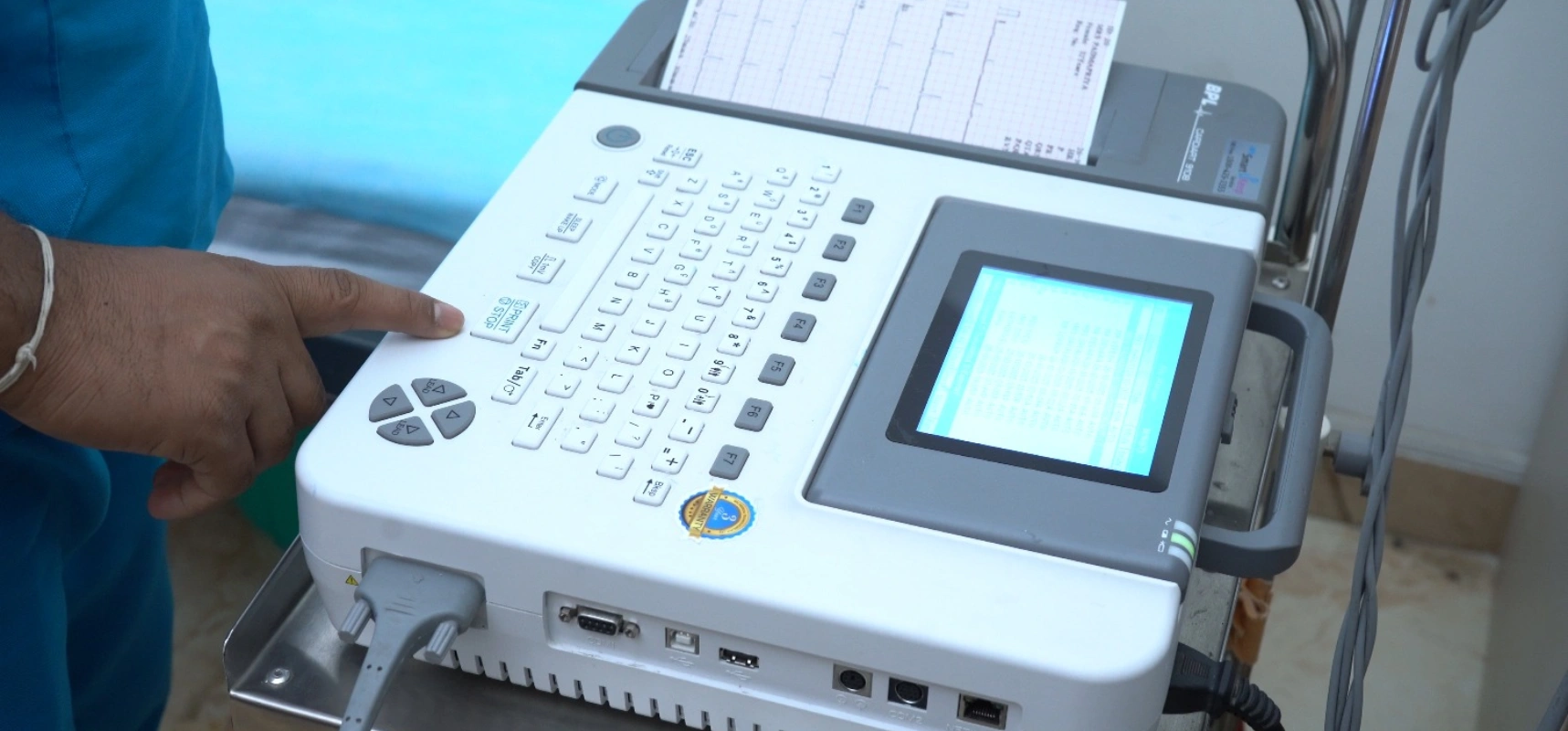
ECG Services
Nano Hospitals provides ECG services in Bangalore to record the heart’s electrical activity using small electrodes placed on the skin. An ECG can help doctors assess heart rhythm and investigate certain heart-related symptoms.
About ECG Services
ECG (Electrocardiogram) Services at Nano Hospitals are essential diagnostic tests used to evaluate the electrical activity of the heart. This quick, non-invasive procedure helps detect heart rhythm abnormalities, blocked arteries, heart muscle damage, and other cardiac conditions.
ECG plays a vital role in early detection of heart disease, emergency cardiac care, and ongoing monitoring of patients with known heart conditions.
Overview
An ECG records the heart’s electrical signals using small electrodes placed on the chest, arms, and legs. These signals are displayed as waveforms that help doctors identify irregular heartbeats, signs of heart attacks, and other cardiac abnormalities.
At Nano Hospitals, ECG tests are performed using advanced digital machines that provide accurate recordings for prompt cardiac evaluation.
Workflow
- Step 1: Medical Assessment Doctors recommend an ECG if a patient experiences chest pain, shortness of breath, palpitations, dizziness, or as part of a routine heart checkup.
- Step 2: Electrode Placement Small adhesive electrodes are placed on the chest and limbs to capture the heart’s electrical signals.
- Step 3: Recording the Heart Activity The ECG machine records heart rhythms for a few minutes while the patient lies still and relaxed.
- Step 4: Analysis The recorded waveforms are reviewed by a doctor to detect rhythm disturbances, ischemia, or structural heart issues.
- Step 5: Reporting and Follow-up Results are shared promptly, and further tests or treatments are planned if needed.
Benefits & Value
For Patients
- Early detection of heart rhythm problems
- Quick evaluation during chest pain or suspected heart attack
- Simple, painless test with immediate results
For Doctors
- Fast cardiac assessment in emergency situations
- Monitoring of ongoing heart conditions
- Evaluation of treatment effectiveness
For the Community
- Improved early diagnosis of cardiovascular disease
- Reduced delays in heart attack detection
- Better preventive cardiac screening access
Risks & Challenges
- No major risks; ECG is very safe
- Mild skin irritation from electrode adhesives in sensitive individuals
- Movement during the test may affect recording accuracy
- May require further tests for detailed cardiac evaluation
Frequently Asked Questions
Is a 12-lead ECG test available at Nano Hospitals across Bannerghatta Road and Uttarahalli? +
Yes, 12-lead Electrocardiogram (ECG) testing is available at both Bannerghatta Road and Uttarahalli branches of Nano Hospitals in Bengaluru. Equipped with digital ECG systems, both emergency departments and cardiology suites provide rapid electrical activity recording for acute chest pain evaluation and routine cardiovascular screening.
What is an ECG test, and what clinical cardiac conditions can it detect? +
An Electrocardiogram (ECG) is a non-invasive diagnostic test that records the heart's electrical signals to evaluate cardiac rhythm and conduction. At Nano Hospitals Bangalore, ECGs detect arrhythmias (atrial fibrillation, tachycardia), myocardial ischemia, acute heart attacks (STEMI/NSTEMI), hypertrophic heart conditions, electrolyte imbalances, and pacemaker functionality.
When should a patient seek an emergency ECG test at Nano Hospitals? +
Patients should seek an immediate emergency ECG at Nano Hospitals Bangalore if experiencing acute chest pain, radiating left arm or jaw discomfort, severe shortness of breath, unexplained dizziness, sudden cold sweats, or persistent heart palpitations. Early ECG evaluation is critical to diagnosing evolving myocardial infarction and preventing cardiac complications.
Are 24/7 emergency ECG testing services operational at Nano Hospitals, Bangalore? +
Yes, emergency 12-lead ECG services operate 24 hours a day, 7 days a week across all Nano Hospitals facilities in Bengaluru. Located directly within casualty and intensive care units, emergency ECGs are performed within minutes of patient arrival to immediately identify life-threatening cardiac events and facilitate rapid cath lab referral.
What is the cost of an ECG test in Bengaluru at Nano Hospitals? +
The cost of an ECG test at Nano Hospitals Bangalore is highly affordable and structured transparently for all patients. Pricing varies depending on whether a standard 12-lead baseline ECG, emergency bedside ECG, or extended cardiac consultation is required, with full coverage accepted under major health insurance plans and government welfare schemes.
How long does a standard 12-lead ECG test take at Nano Hospitals? +
A standard 12-lead ECG test at Nano Hospitals Bangalore takes approximately 5 to 10 minutes from electrode placement to tracing completion. The actual electrical recording phase takes under 60 seconds, allowing for fast, non-invasive cardiac evaluation without causing disruption to emergency or routine clinical workflows.
Is an ECG test painful, uncomfortable, or dangerous for cardiac patients? +
No, an ECG test is completely painless, non-invasive, and risk-free. Small adhesive chest electrodes and limb leads are placed on the skin to passively record intrinsic cardiac electrical impulses. No electricity is transmitted into the body, ensuring complete safety during testing at Nano Hospitals Bangalore.
What preparation or fasting instructions are needed before an ECG test? +
No special fasting or dietary preparation is required before undergoing a standard ECG at Nano Hospitals Bangalore. Patients can eat, drink, and take prescribed cardiovascular medications normally. Advisable steps include wearing loose-fitting upper body clothing and avoiding heavy skin lotions or chest creams prior to electrode attachment.
Can a 12-lead ECG test accurately detect an active heart attack? +
Yes, a 12-lead ECG is the primary diagnostic tool used to confirm an active heart attack at Nano Hospitals Bangalore. It identifies ST-segment elevation (STEMI), T-wave inversions, and abnormal Q-waves, allowing attending cardiologists to pinpoint coronary artery blockage and initiate rapid thrombolysis or emergency coronary angioplasty.
Is an ECG test safe and recommended for elderly and frail patients? +
Yes, an ECG test is entirely safe, non-invasive, and strongly recommended for elderly patients at Nano Hospitals Bangalore. Because the procedure involves zero ionizing radiation, thermal energy, or skin disruption, senior patients with hypertension, diabetes, or structural heart disease can undergo frequent baseline ECG monitoring without side effects.
Is an ECG test routinely included in preventative executive health checkups? +
Yes, a baseline 12-lead ECG is a standard component of routine master health checkup packages at Nano Hospitals Bangalore. Screening assists in detecting silent cardiac ischemia, hidden arrhythmias, and age-related ventricular hypertrophy before clinical symptoms appear, providing baseline electrical data for future cardiovascular comparison.
Why choose Nano Hospitals for diagnostic ECG and cardiac care in South Bengaluru? +
Nano Hospitals is a top-rated facility for diagnostic cardiology in South Bengaluru, offering state-of-the-art digital ECG machines, 24/7 emergency casualty testing, rapid report verification by senior cardiologists, affordable pricing, and strategic dual-branch accessibility across Bannerghatta Road and Uttarahalli for comprehensive heart care.
What clinical next steps occur after an ECG test is completed at Nano Hospitals? +
Following an ECG test at Nano Hospitals Bangalore, a physician or attending cardiologist reviews the wave tracing. If abnormalities like ischemia or arrhythmia are detected, the doctor recommends immediate emergency interventions or secondary diagnostic evaluations, such as 2-D Echocardiography, TMT stress testing, or Holter monitoring.
How to book an ECG test or walk in for cardiac evaluation at Nano Hospitals, Bangalore? +
EEG consultations and tests at Nano Hospitals Bangalore can be scheduled online via eeg-services or by calling the hospital. Patients can also visit the hospital reception desk to book an appointment. EEG services are available at both Bannerghatta Road and Uttarahalli branches.