




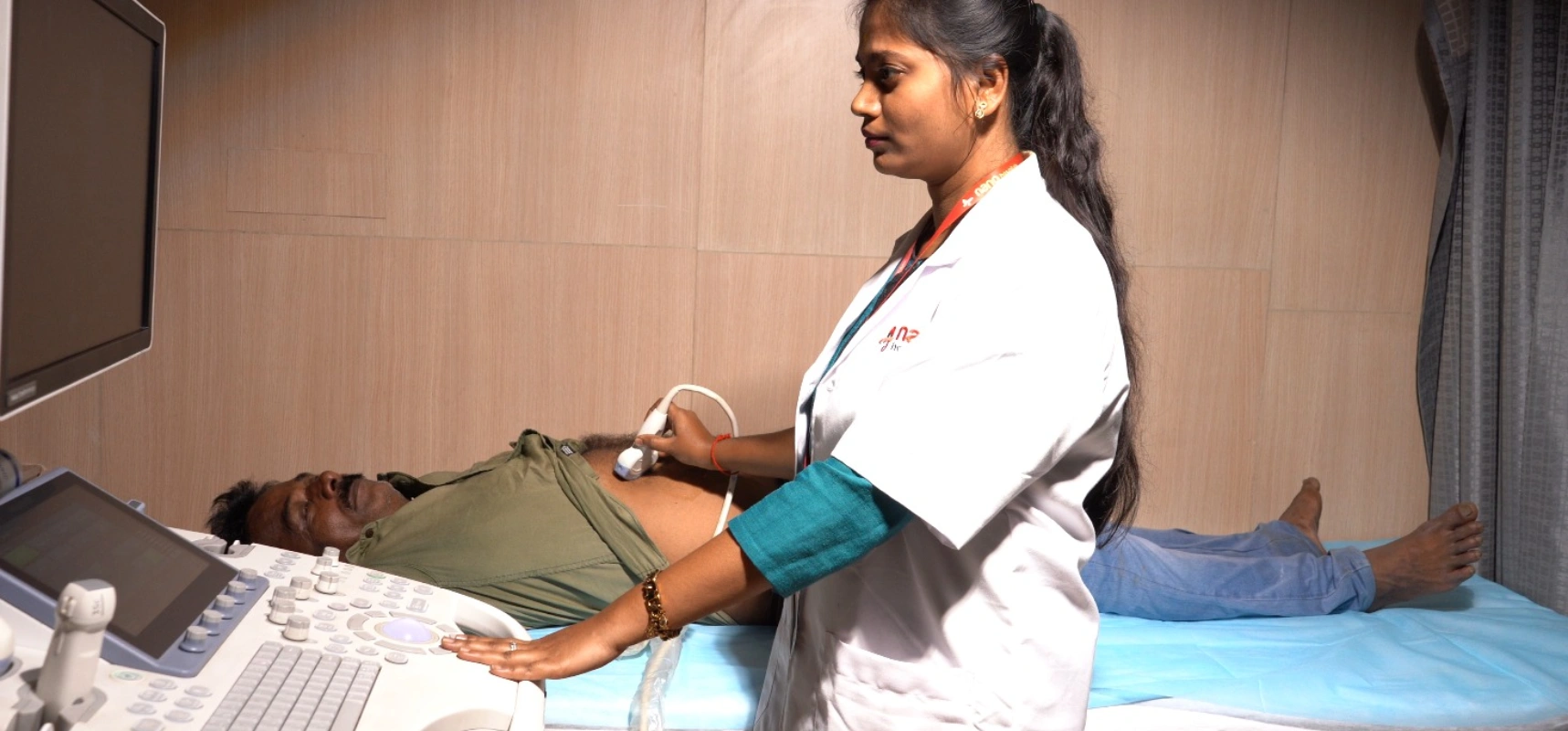
Ultrasound
Nano Hospitals provides ultrasound imaging in Bangalore using high-frequency sound waves to examine abdominal organs, pelvic structures, the thyroid, breast, soft tissues and blood flow. This radiation-free technique supports early diagnosis, pregnancy monitoring and image-guided procedures, led by experienced radiologists and sonographers at both Bannerghatta Road and Uttarahalli branches.
About Ultrasound
Ultrasound Services at Nano Hospitals provide safe, non-invasive imaging to visualize internal organs, blood flow, and developing fetuses using high-frequency sound waves. This radiation-free technique supports early diagnosis, pregnancy monitoring, and guidance for various medical procedures.
Ultrasound plays a key role in evaluating abdominal organs, pelvic structures, thyroid, breast, soft tissues, and vascular conditions.
Overview
Ultrasound imaging uses high-frequency sound waves that bounce off internal structures to create real-time images on a monitor. It is widely used for examining the liver, kidneys, gallbladder, uterus, ovaries, prostate, thyroid, and soft tissues. Doppler ultrasound additionally assesses blood flow in arteries and veins.
At Nano Hospitals, ultrasound examinations are performed using modern high-resolution machines for accurate and timely diagnosis.
Workflow
- Step 1: Doctor’s Referral A physician recommends ultrasound to investigate pain, swelling, pregnancy, organ function, or suspected abnormalities.
- Step 2: Preparation Depending on the scan type, patients may need to fast or have a full bladder for better image clarity.
- Step 3: Gel Application A water-based gel is applied to the skin over the area being examined to help transmit sound waves.
- Step 4: Image Acquisition The radiologist or sonographer moves a handheld probe over the skin to capture real-time images of internal organs.
- Step 5: Interpretation and Report Images are analysed by a radiologist, and a diagnostic report is prepared for the treating doctor.
Benefits & Value
For Patients
- Safe imaging without radiation exposure
- Painless and non-invasive procedure
- Early detection of organ and soft tissue conditions
For Doctors
- Real-time visualization of internal structures
- Guidance for procedures like biopsies and fluid drainage
- Reliable monitoring of pregnancy and fetal development
For the Community
- Accessible diagnostic imaging for various medical needs
- Early disease detection and preventive care support
- Improved maternal and fetal health monitoring
Risks & Challenges
- Generally very safe with no known harmful radiation
- Image quality may be limited in obese patients or excessive bowel gas
- Some scans require preparation such as fasting or a full bladder
Frequently Asked Questions
Is ultrasound imaging safe during pregnancy for the mother and developing fetus? +
Yes, ultrasound imaging is exceptionally safe during pregnancy for both mother and fetus. At Nano Hospitals Bangalore, diagnostic ultrasonography utilizes high-frequency sound waves—not ionizing radiation—to produce real-time images, allowing safe, non-invasive monitoring of fetal development, placental location, and amniotic fluid volume throughout all trimesters.
Does an ultrasound scan hurt, and what can patients expect during the procedure? +
No, standard external ultrasound scans are completely painless. At Nano Hospitals Bangalore, radiographers apply a clear, water-based acoustic gel to the skin and gently glide a smooth transducer probe over the body area. Patients experience only light contact pressure without tissue irritation or discomfort.
How long does an ultrasound scan take at Nano Hospitals? +
An ultrasound scan at Nano Hospitals Bangalore typically takes 15 to 30 minutes to complete. Specialized evaluations, such as detailed fetal anomaly scans, 3D/4D obstetric imaging, or complex vascular Doppler studies, may require up to 45 minutes for thorough diagnostic data collection and analysis.
Do I need to fast or drink water before an ultrasound scan? +
Preparation depends on the specific organ being examined. At Nano Hospitals Bangalore, upper abdominal ultrasounds (liver, gallbladder, pancreas) require fasting for 6 to 8 hours, whereas pelvic and early pregnancy scans require drinking 3 to 4 glasses of water to maintain a full bladder for visual clarity.
What diseases and medical conditions can an ultrasound scan detect? +
Ultrasound imaging detects gallstones, kidney stones, fatty liver disease, uterine fibroids, ovarian cysts, thyroid nodules, vascular blood clots, and soft tissue masses. At Nano Hospitals Bangalore, radiologists combine high-resolution ultrasonography with Doppler imaging to evaluate organ structure, blood flow, and soft tissue pathologies.
How can patients book an ultrasound scan at Nano Hospitals, Bangalore? +
Yes. Ultrasound services at Nano Hospitals Bangalore can be scheduled by appointment through ultrasound, by calling the hospital, or by visiting the hospital reception desk. Ultrasound services are available at both Bannerghatta Road and Uttarahalli branches.