




ABI(Ankle-Brachial Index)
Nano Hospitals offers Ankle-Brachial Index (ABI) testing in Bangalore, a painless 10–15 minute screening that compares arm and ankle blood pressure to detect peripheral artery disease (PAD). It's especially useful for diabetic and high-risk cardiac patients, with results interpreted by vascular specialists at both Bannerghatta Road and Uttarahalli branches.
About ABI(Ankle-Brachial Index)
Ankle-Brachial Index (ABI) is a simple, non-invasive diagnostic test used to compare blood pressure in the ankle and arm to assess blood flow and detect peripheral artery disease (PAD)
It helps identify blockages or narrowing in the arteries of the lower limbs.
Overview
Detects peripheral artery disease (PAD)
Assesses risk of poor circulation in legs
Useful in diabetic and high-risk cardiac patients
Helps evaluate leg pain during walking (claudication)
Assists in monitoring vascular treatment outcomes
Workflow
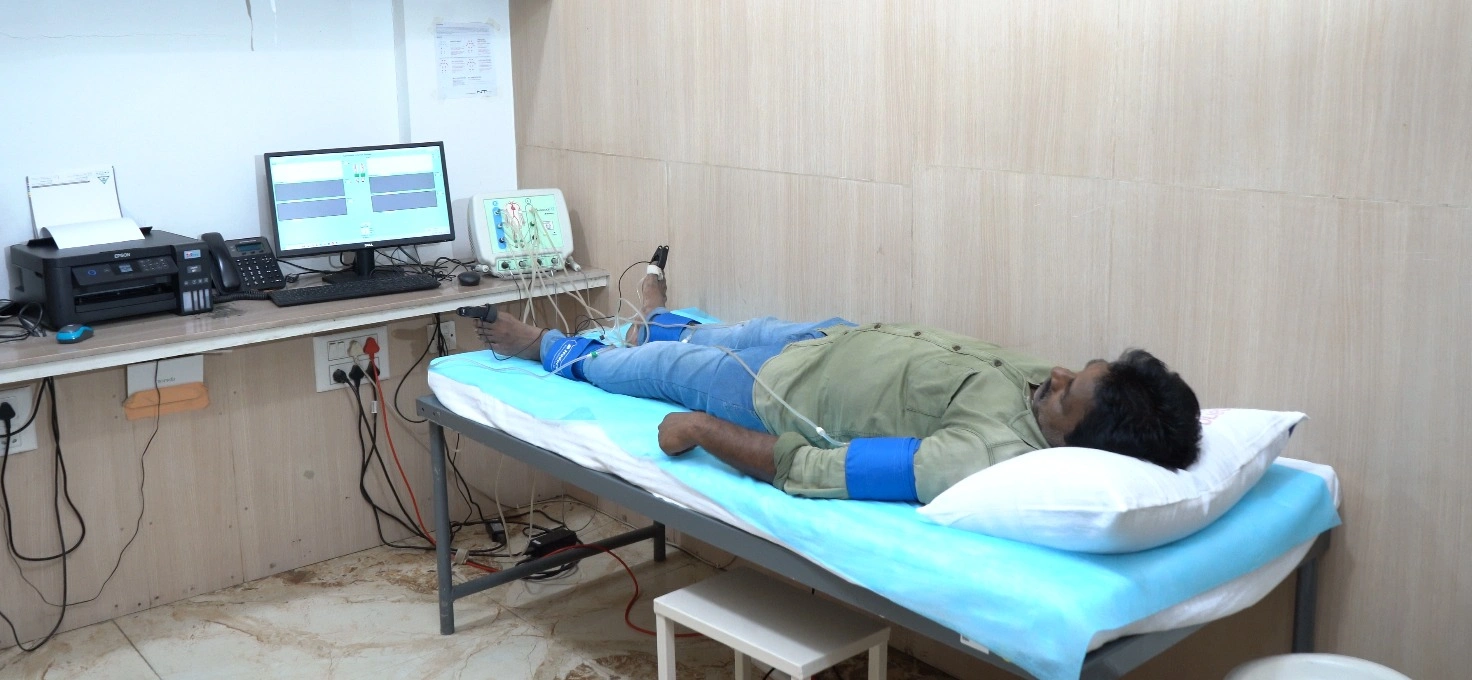
- Step 1: Patient Positioning Patient lies in a relaxed, supine position.
- Step 2: Blood Pressure Measurement (Arm) Blood pressure cuff is placed on the arm and readings are taken.
- Step 3: Blood Pressure Measurement (Ankle) Cuff is placed on the ankle; Doppler device measures arterial pressure.
- Step 4: Ratio Calculation Ankle pressure is divided by arm pressure to calculate ABI.
- Step 5: Interpretation Values are analyzed to determine normal or reduced blood flow.
- Step 6: Reporting Results are documented and explained to the patient.
Benefits & Value
For Patients
Early detection of circulation problems
Painless and quick screening test
Helps prevent serious complications like ulcers or amputation
For Caregivers & Families
Identifies vascular risks early
Supports preventive care and lifestyle modification
Reduces complications from untreated PAD
For the Community
Promotes awareness of vascular health
Reduces incidence of limb-related complications
Supports preventive screening programs
Risks & Challenges
No significant risks (completely safe procedure)
Accuracy may vary in patients with calcified arteries (e.g., diabetes)
Requires proper technique for reliable results
Frequently Asked Questions
Is the Ankle-Brachial Index (ABI) test painful or invasive? +
No, the Ankle-Brachial Index (ABI) test is a completely non-invasive and painless vascular diagnostic procedure performed at Nano Hospitals Bangalore. Similar to a standard blood pressure measurement, inflatable cuffs are placed around the arms and ankles to record systolic pressure using a Doppler ultrasound probe.
How long does an Ankle-Brachial Index (ABI) vascular test take to complete? +
An Ankle-Brachial Index (ABI) test typically takes 10 to 15 minutes to perform at Nano Hospitals Bangalore. Patients rest comfortably on an examination table while blood pressure readings are measured at both arm and ankle arteries, followed by immediate clinical calculation of the vascular pressure ratio.
What pre-test preparation or fasting is required before an ABI test? +
No special diet, fasting, or medication adjustments are required prior to undergoing an Ankle-Brachial Index (ABI) test at Nano Hospitals Bangalore. Patients are advised to wear loose-fitting, comfortable clothing that allows easy access to both upper arms and lower legs, and rest for 10 minutes before testing.
Can an Ankle-Brachial Index (ABI) test detect blocked leg arteries and Peripheral Artery Disease (PAD)? +
Yes, an Ankle-Brachial Index (ABI) test accurately detects reduced arterial blood flow caused by blocked leg arteries and Peripheral Artery Disease (PAD). By comparing ankle and arm systolic blood pressures, the test identifies arterial narrowing, plaque buildup (atherosclerosis), and circulatory impairment early to prevent severe vascular complications.
Is the Ankle-Brachial Index (ABI) test safe for elderly, diabetic, and high-risk cardiac patients? +
Yes, the ABI test is completely safe for elderly patients, individuals with diabetes, smokers, and high-risk cardiac patients at Nano Hospitals Bangalore. Because it involves zero ionizing radiation, needle sticks, or dye injections, it serves as an ideal routine vascular screening tool for aging or immunocompromised individuals.
How to book an ABI vascular screening appointment at Nano Hospitals in Bannerghatta Road or Uttarahalli? +
Patients can schedule an Ankle-Brachial Index (ABI) test at Nano Hospitals Bangalore online at abi, by calling the hospital reception desk, or walking in directly at Bannerghatta Road and Uttarahalli branches for preventative vascular screening and diagnostic consultation.